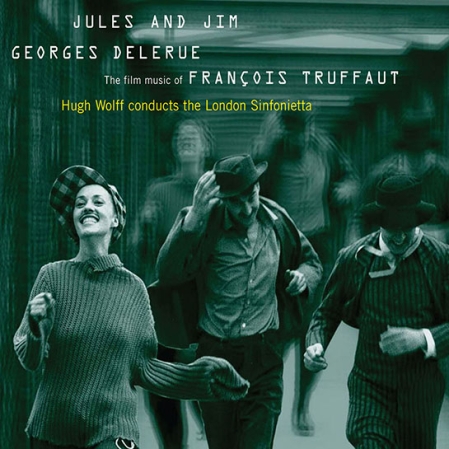
French composer Georges Delerue (1925-92) studied with Darius Milhaud at the National Conservatory of Music in Paris before going on to compose over 350 film and television scores, most notably for famed French New Wave pioneer François Truffaut. As part of the Nonesuch Film Series, the London Sinfonietta recorded an album of music from their work together.
Georges Delerue was a highly prolific film composer born in Roubaix, France, in 1925. He began his musical studies at the local conservatory in Roubaix just as World War II was breaking out across Europe and was forced to simultaneously work in a factory to help support his family. Despite the turmoil of war, Delerue was able to continue his studies and enroll at the National Conservatory of Music in Paris. While there he was encouraged by one of his teachers, composer Darius Milhaud, to pursue composing for the theatre. His work with the theatre quickly blossomed to including film scoring.
Delerue then went on to compose over 350 film and television scores, as well as symphonies and music for dance, theatre, and opera. He worked with numerous directors in Europe and America, one of his most fruitful relationships being with famed French New Wave pioneer François Truffaut. The two completed 11 films together, beginning with Shoot the Piano Player in 1960 and also including Jules and Jim. As part of the Nonesuch Film Series, the London Sinfonietta recorded an album of music from Delerue’s work with Truffaut. "Many of these scores have a shimmering atmospheric quality that recalls Debussy," said the New York Times, "and other effects that evoke Satie."
George Delerue received numerous awards for his work, including the Rome Prize, an Emmy Award, an Academy Award, and multiple Cesar Awards, and was named a Commander of Arts and Letters in France. He died of a heart attack in 1992 while recording a score in Los Angeles.