
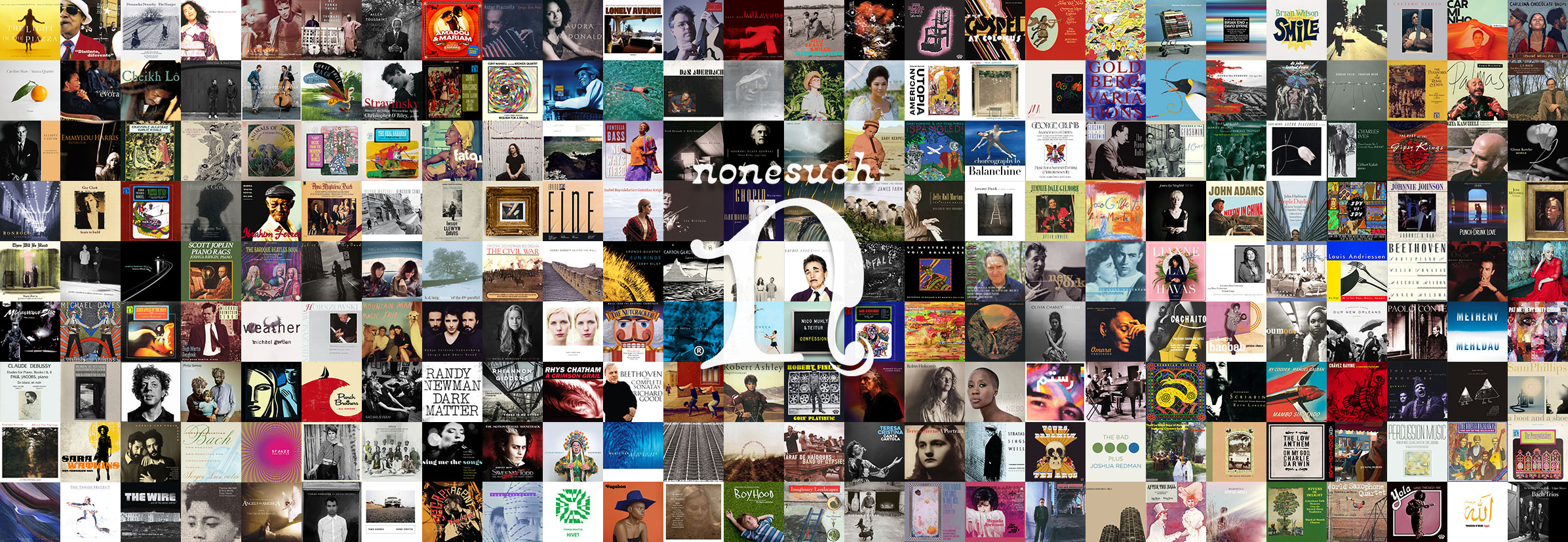
The Nonesuch Story
By Michael Hill
- Introduction
- Early History
- Change in Leadership
- New Directions
- Leaving Elektra
- The Business of Nonesuch
- Nonesuch Today
- Grammy Award Winners
Founded as a budget classical label in 1964 by Jac Holzman, head of the then-independent Elektra Records, Nonesuch Records has grown over the last five decades to pursue a broad mission, including classical music, contemporary music, jazz, music theatre, traditional American and world music, popular and alternative music.
In a business filled with constant change, its leadership has been remarkably stable: two people—the late Tracey Sterne and, from 1984 to 2017, Bob Hurwitz—were at the helm for 47 of those years; David Bither, who joined Nonesuch in 1995 as Senior Vice President, became President in 2017, when Hurwitz became Chairman Emeritus. Nonesuch, wrote the Boston Globe a few years back, is "an oasis of artistic excitement. When one picks up a Nonesuch CD, there is a sense of occasion, the feeling that the artists in question have been assembled not only as an exercise in star power, but as an exercise in artistic exploration."
Though the face of Nonesuch has changed dramatically in the years since Tracey Sterne was leading the company, the label has retained many of its most important aspects during its history. Above all, the label has always been at the forefront of contemporary classical music during both the Sterne (George Crumb, Elliott Carter, William Bolcom) and Hurwitz (John Adams, Steve Reich, Kronos Quartet, Philip Glass, Louis Andriessen, Frederic Rzewski, Henryk Górecki) eras.
During Sterne's tenure, Nonesuch began the most ambitious series of world music recordings in the commercial record business up to that point, with its more than 100 releases from the Explorer Series; Nonesuch has since been active working with many of the leading artists from around the world, including legendary Brazilian singer/songwriter Caetano Veloso, the late Argentinean composer Astor Piazzolla, Senegalese icon Youssou N'Dour, and, through its long-time association with World Circuit Records, the unforgettable recordings of the Buena Vista Social Club and Ibrahim Ferrer from Cuba, Senegal's Orchestra Baobab and Cheikh Lô, Mali's Toumani Diabaté and Ali Farka Touré, and the Malian-Cuban collaboration AfroCubism.
In its early days, Nonesuch released landmark recordings of Scott Joplin's music that reached wide audiences and commissioned new recordings of songs by composers like Charles Ives and Stephen Foster. During the past 25+ years, the label made important historical contributions with its George and Ira Gershwin Library of Congress series, classic piano roll recordings of George Gershwin and Jelly Roll Morton, and the theater songs of Kurt Weill, Rodgers and Hart, Leonard Bernstein, and Vernon Duke.
Classical music has always been a major foundation of the label. During its early years significant recordings were made by Jan DeGaetani, Paul Jacobs, and Gilbert Kalish, among others; in later years, Nonesuch released many memorable albums by Richard Goode, Dawn Upshaw, Lorraine Hunt Lieberson, and Gidon Kremer.
In the past three decades, Nonesuch also expanded into new areas of repertoire. It started recording jazz in 1984, with the now-classic World Saxophone Quartet Plays Duke Ellington, and through the years worked with Bill Frisell, Fred Hersch, Brad Mehldau, Pat Metheny, Joshua Redman, and John Zorn. The company has taken an active role in American music theater, including seven recordings of shows and soundtracks by Stephen Sondheim and all three major works by Adam Guettel.
The company has worked closely with the New York City Ballet and The George Balanchine Trust, releasing videos of many of Balanchine's most important ballets, as well as important works by Mark Morris, Paul Taylor, and Twyla Tharp. The company has been selectively involved with the soundtracks of a number of acclaimed television programs (The Civil War, Angels in America, The Wire) and films (Powaqqatsi, Wings of Desire, Requiem for a Dream, Kundun, The Hours, The Thin Blue Line, There Will Be Blood, Sweeney Todd, Revolutionary Road, I Am Love, True Grit, Norwegian Wood, Inside Llewyn Davis, Boyhood). The company also made landmark recordings of film scores by Georges Delerue, Alex North, Toru Takemitsu, and Leonard Rosenman.
Finally, over the last 15 years, Nonesuch has entered into the adult and alternative pop worlds. Many of the world's leading singers and songwriters—including Emmylou Harris, Randy Newman, Robert Plant, David Byrne, Natalie Merchant, k.d. lang, Joni Mitchell, and Brian Wilson,—have made important albums for Nonesuch during this period. And the label has begun recording a new generation of musicians, including The Black Keys, Punch Brothers, Chris Thile, Carolina Chocolate Drops, Rhiannon Giddens, Conor Oberst, Nickel Creek, Sam Amidon, Devendra Banhart, and Lake Street Dive.
As a testament to Nonesuch's success in fulfilling its broad mission, in 2004, Nonesuch won Grammys in four different musical genres, including best classical album (and best contemporary classical composition-both John Adams), best alternative album (Wilco), best world music album (Youssou N'Dour), and best jazz ensemble album (Bill Frisell).
Early History
Nonesuch Records was conceived more than 50 years ago as an experiment in hip, '60s-style entrepreneurship. In 1964, Jac Holzman came up with an idea to create a budget classical music label aimed at the same youthful audience that was buying classic literature in paperback editions. As Holzman told the New York Times, "Classical records went for $5, and I put them out for $2.50. I liked $2.50 because it was the price of a trade paperback." Holzman didn't commission new recordings; instead, he licensed existing albums from small European labels and repackaged them for a US audience, commissioning artfully groovy covers regarded by some to be as collectible as the albums they contained.
Over the years, reports have suggested that the first year's worth of Nonesuch releases generated sufficient income to help support the pop side of Elektra and enable Holzman to sign such acts as the Doors and Love. At the very least, the fledgling Nonesuch was successful enough to prompt major label competitors to embark on their own similarly high concept / low budget classical lines for young consumers.
To bolster his operation, Holzman brought over Teresa "Tracey" Sterne from Vanguard, where she'd worked alongside label head Seymour Solomon. The Brooklyn-born Sterne had been a child prodigy. (In 2000, on the album A Portrait, Nonesuch paired a recording of performances she made as a teenager with a selection of recordings she supervised during her time at the label.) She pursued an adult career as a concert pianist before deciding to shift her focus to the business side of the classical music industry, first as a publicity assistant with Sol Hurok's concert-producing organization and then with Columbia Records, before moving over to Vanguard. Sterne brought as much passion and drive to her work behind the scenes as she did to her concert appearances; she was a brilliant, uncompromising executive who bonded deeply with the artists she signed, doggedly championed their music, and insisted that each element of a Nonesuch release adhere to the highest of standards.
Sterne was officially called the label's coordinator, but she preferred the title of editor. She carefully selected material from the European classical sources Holzman had cultivated and began to build her own roster of artists, culling talent from the contemporary classical and new-music circles of New York City. Projects she developed at Nonesuch routinely garnered critical acclaim and, on occasion, found serious commercial success.
Composer George Crumb's Ancient Voices of Children, inspired by the poems of Federico Garcia Lorca, sold more than 70,000 units, a remarkable feat for a challenging and brilliant modern piece from an avant-garde source. It was performed by the Contemporary Classical Ensemble (CCE) and featured mezzo-soprano Jan DeGaetani, a close colleague of Sterne's who displayed an unflagging commitment to such pieces. (DeGaetani was also an influential teacher; Nonesuch artist Dawn Upshaw was one of her students.) CCE co-founder Charles Wourinen was commissioned by Sterne to create a piece for synthesized instrumentation; his resulting Time's Encomium won the Pulitzer Prize for Music in 1970. And a young musicologist who worked with Sterne, Joshua Rifkin, introduced Scott Joplin's music to a vast audience, resulting in the company's first million-selling record and igniting a passion for ragtime jazz in a mainstream audience.
Perhaps most significantly, Sterne established the Nonesuch Explorer Series, which presented indigenous music from around the world, beginning with field recordings brought to Sterne by inveterate traveler-musicologist David Lewiston and produced for disc by Peter Siegel.
This was "world music" at its purest-much of it, like the Balinese sounds on Music from the Morning of the World and Golden Rain, hitherto unheard in the West. (The former was inducted into the National Recording Registry of "culturally significant" sound recordings in 2008.) The Explorer Series was not simply an anthropological mission: Sterne considered the work to be on the same aesthetic level as that of any Western Nonesuch artist. The series found enthusiastic followers, including a counter-cultural listenership that employed pieces like the 22-minute long "Monkey Chant" from Golden Rain as soundtrack for their chemically altered armchair travels.
Milo Miles, the world- and American-roots music critic for NPR's Fresh Air, recently testified on the program to the series' impact:
When I was a teenager, every record store indicated that music from other countries was unimportant. Foreign music albums had cruddy covers. They were dusty and stuck in the back. The only people who bought them must have been immigrants. The Nonesuch Explorer Series changed all that. The covers were bright and lively, with intriguing art and a look of something both hip and professional. The terrific two-LP sampler could provide a first exposure to Indonesian gamelan, Japanese wooden flute, and African thumb piano.
And the San Francisco Chronicle said:
Flash back to the 1960s, when the Explorer Series began. Pioneers from Benjamin Britten to the Beatles had begun to steadily open our ears to what seemed like exotic sounds. Everyone, it seemed, was open to new ideas. In this atmosphere Nonesuch's Music from the Morning of the World exploded as a chart-topper in the 1960s, alongside the then-new Nonesuch recordings of songs and dances from Mexico and the Bahamas that inaugurated the series' recordings of overlooked music of the New World. This was all happening when most Americans thought Mexican music meant mariachis, when reggae was not a household word, when Andean flutes were not ubiquitous in soundtracks, when Cuban music was dying along with most of Cuban culture under Communism, and when Brazilian music was about to take over as the dominant influence in international pop. It is definitely cool to be reminded that the Grateful Dead's "I Bid You Goodnight" was a song Jerry Garcia first heard on the The Real Bahamas. There is a lot of learning, a lot of enjoyment in the Explorer Series. The mix of true folk music and fascinating local pop is one of the virtues of any batch of Explorers.
Holzman sold Elektra to Warner Communications in 1970. When Nonesuch turned 15 in 1979, critic Peter G. Davis wrote, in a New York Times article entitled "The Special Touch of Nonesuch," that the label "has always been run with the kind of personal touch that creates a flavor of autonomy and generates quality. Warner's enlightened 'hands off' policy has no doubt helped encourage this salutary effect, for it means that Teresa Sterne, who has guided Nonesuch's fortunes for most of its 15 years can more or less do things her way."
Sterne's strong guiding hand had cemented the reputation of Nonesuch with savvy listeners and critics, but her fastidious approach held less sway with the corporate heads. In December of 1979, merely months after Davis had lavished such praise on her stewardship, Sterne made headlines in the Times again: she had been abruptly dismissed from her job at the behest of Elektra chairman Joe Smith. Sterne expressed "complete surprise and shock" to a reporter, though she did speculate that weaker sales might have prompted the move. Her firing prompted an outcry from the label's artists and New York City's creative community at large. More than 2,000 people wrote to the head of Warner Communications in protest, and all of the artists on the label sent a signed petition to the New York Times objecting to her ouster.
Change in Leadership
The label operated from Los Angeles for the next four years under the direction of Keith Holzman, Jac's younger brother. Many of the artists Sterne had signed, though disgruntled, chose to remain on the label without their mentor, perhaps because Sterne had done her job so well: There simply was no other label for these iconoclastic artists to go to.
The singular reputation that Nonesuch accrued under Sterne—and the tremendous potential it still held—was not lost on Warner Bros. Records executive and former Blue Thumb Records chief Bob Krasnow when he took over the chairmanship of Elektra Records in 1983. He decided to bring in the 34-year-old Robert Hurwitz, the young head of American operations for ECM, the jazz and new-music label that was, at the time, being distributed by Warner Bros., a deal Krasnow had brokered.
Hurwitz, a Los Angeles native raised, as he told the New York Times, in "a fairly evolved household as far as music was concerned," was himself a pianist who came to New York City at the age of 21, determined to either pursue a career as a musician or break into the record business. His first job was at Columbia Records, where he was hired as a publicity writer. At Columbia, Hurwitz met four people who would have a big impact on his career: Karin Berg, Manfred Eicher, John Hammond, and Godard Lieberson.
Berg, who would go on to become the first woman in the industry to be a significant A&R force, persuaded Columbia to hire him and was an important mentor. He met Manfred Eicher, the head of ECM Records when Eicher came looking for a distribution deal at Columbia; they hit it off immediately and Eicher told Hurwitz that he wanted him to run ECM's American company, as soon as he could find someone to release the records. Hurwitz got to know the great A&R man John Hammond well and spent time with Lieberson, the legendary head of Columbia; he was deeply influenced by the values and high standards they represented. Hurwitz continually looked to many of Lieberson's artistic (and business) values as he sought a new direction for Nonesuch.
True to his word, in 1975 Eicher hired Hurwitz, then 25, to run ECM in America. They worked together for nine years, and during that time Hurwitz began relationships with four musicians who would ultimately join him at Nonesuch: Pat Metheny, Bill Frisell, Steve Reich, and John Adams. During Hurwitz's first years at ECM, the company was wildly successful (it was the time of Keith Jarrett's Köln Concert, Chick Corea's Return to Forever, and the launch of Metheny's career), and in the late 1970s, every important American company was now interested in distributing the label. In 1978, the company was signed to Warner Bros. by Krasnow.
Krasnow took over Elektra in 1982 and brought Hurwitz over in the fall of 1984. (He had made the offer 20 years to the day after the label's founding.) Hurwitz was refreshingly low-key in his approach and demeanor, though his passion, knowledge, and authority immediately came through, no matter how soft-spoken the conversation might be. Krasnow, confident in his hire, encouraged Hurwitz to view Nonesuch as a tabula rasa; he would be free to pursue his own vision of the label. "Talk to me in five years," Krasnow, only somewhat facetiously, told him.
Perhaps Krasnow simply anticipated how busy Hurwitz would be. As Hurwitz now recalls, "The first two years were incredibly fertile. We were able to sign Steve Reich and John Adams, and start working with Philip Glass, Kronos Quartet, and John Zorn. It was a time when most of the classical divisions of major labels were asleep. They were so busy devising genre "crossover" projects and re-issuing catalogue on CD, still a new technology at that time, that few people were doing anything from an A&R point of view." In 1985, Nonesuch released Reich's Desert Music and Adams's Harmonielehre. A year later came Kronos Quartet's self-titled debut, Zorn's Spillane, World Saxophone Quartet's Plays Duke Ellington, and Sérgio and Odair Assad's debut recording. Of the label's past roster, classical pianist Richard Goode and soprano Teresa Stratas remained.
Hurwitz's initial signing of new-music mavericks mirrored the adventurous spirit that Sterne had established. But their sound and sensibility were radically, almost defiantly different. The recordings of Adams, Glass, and Reich, as well as the new-music aesthetic of Kronos, seemed to contrast sharply with the more cerebral, European-influenced new music favored in the early days of Nonesuch. Hurwitz, who had admiration for much of the older Nonesuch's new-music perspective, was well aware of the conflict between generations, and although a few new recordings were released reflecting those older values—by composers like Carter, Leon Kirchner, and George Perle—he felt the future course was in the hands of musicians closer to his own generation, the music he loved the most.
More immediately, for the revitalized Nonesuch, these artists found a record-buying audience. "I think it's a wonderful irony," muses Hurwitz, "because the recording of new music is possibly the least commercially viable aspect of anything one can do in the record business. But all of our initial successes came out of that area." The first three Kronos albums sold close to 100,000 copies, an unheard of result from a string quartet playing modern music; their fifth, Pieces of Africa, sold close to 400,000 and was the number one record on Billboard's classical and world music charts simultaneously. Early Glass soundtracks of Mishima and Powaqqatsi sold more than 100,000, as did Different Trains and Desert Music by Steve Reich.
Finally, the now-landmark recording of Polish composer Henryk Górecki's Third Symphony sold more than one million copies, the highest selling album ever by a contemporary composer. Górecki's solemn and moving symphony, a minimalist hymn to the suffering of his native people in World War II, was performed by the London Sinfonetta and Dawn Upshaw. The reclusive Górecki had composed the piece in 1976, but it didn't appear on disc until 1992. Repeated exposure on Classic FM radio in London helped to propel the recording into an unprecedented #6 spot on the British pop charts. Emotionally affected listeners transformed Symphony No. 3 into a cultural phenomenon. Górecki himself speculated, "Perhaps people find something they need in this piece of music … Somehow I hit the right note, something they were missing."
"These kinds of records not only gave us credibility," says Hurwitz, "they sent a signal out to the musical community about what we were doing. We got caught up in a wave at absolutely the right moment."
New Directions
During the first few years under Hurwitz's leadership, Nonesuch also began recording jazz artists and composers who were part of the burgeoning downtown New York scene, like John Zorn and Wayne Horvitz. The company released four acclaimed recordings from Zorn (Naked City, Spillane, The Big Gundown, and Spy vs. Spy) and a half-dozen recordings from the World Saxophone Quartet, and began a long relationship with guitarist Bill Frisell.
Whereas the signings of Adams and Reich (who were both given exclusive composer contracts, which continue through this day) could be seen in the context of a time-honored tradition of the record business (Lieberson at Columbia had signed Copland and Stravinsky; Decca had signed Britten; Deutsche Grammophon had signed Stockhausen and Henze), the introduction of Kronos, Zorn, and soon afterwards, the Brazilian singer Caetano Veloso, all symbolized the greatest break from Nonesuch's past, and opened up opportunities that would come in the future.
As prescient as these signings seem now, Hurwitz believes "those things at the time were obvious and easy to do. But for me, the most dramatic turning point was when the opportunity came to work with Caetano Veloso. That was a moment when we could do something really different."
Signing the Brazilian singer-songwriter, a founding member of the voraciously eclectic, politically subversive late-'60s Tropicalismo movement, asserts Hurwitz, "turned everything on its head." He recalls:
I inherited a company that was beloved by many for its rich classical music tradition, and suddenly one day there is a genuine pop musician like Caetano. In one respect, he did not fit in any of the criteria that were established for the company, and yet he was artistically on as high a level as anyone performing music at that time. It broke down a wall, and perhaps at that moment, Nonesuch ceased to be "a classical label." Suddenly, so much more was now possible. Years later, hearing Lorraine Hunt Lieberson sing Caetano's "Tradicão" as beautifully as she had sung Bach, Handel, Lieberson, or Adams, my initial instincts were reaffirmed.
With Veloso, Hurwitz had ventured into intriguingly uncharted territory for the label, with an artist who was, for an audience outside the US, a genuine pop star. This wasn't world music, just worldly, and that sensibility informed subsequent international deals at the label. In 1987, Nonesuch released Le Mystère des Voix Bulgares, a collection of a cappella performances by a Bulgarian State Television female choir that was as entrancingly strange as it was beautiful, full of otherworldly harmonies. The album was a press sensation and a left-field commercial hit, despite its Bulgarian lyrics; it became a cultural event, like so many Nonesuch releases. A year later, Astor Piazzolla, elegant master of the Argentine nuevo tango, made his first recording for the label.
The Bulgarian record began a new period of commercial prosperity for the company; where new music had fueled the label in the few years of the post-Sterne era, now, suddenly, the label caught a wave with world music. Soon after the Bulgarian success, Hurwitz brought the Gipsy Kings to Nonesuch; the group's self-titled debut became a grown-up pop hit, selling more than a million copies and launching a career that has thrived for 20 years-in fact, eleven of the 50 top-selling Nonesuch releases are by the Gipsy Kings. The 1997 landmark Buena Vista Social Club, at close to three million units, became the best-selling album in the company's history, and Nonesuch has sold hundreds of thousands of albums by musicians attached to that project, including Ibrahim Ferrer, Rubén González, and the Afro-Cuban All-Stars. Piazzolla made two of his last albums for Nonesuch, both of which sold in the hundreds of thousands, as did Tango Zero Hour, now licensed to Nonesuch, and the first two albums of Piazzolla's music by Gidon Kremer. Nonesuch also had tremendous success with the great Senegalese artist Youssou N'Dour.
Leaving Elektra
Though Hurwitz would say that Nonesuch's primary concern was always to be driven by artistic considerations, it was clearly part of a commercial business, part of the world's largest record company (and media company, as parent Warner Communications had merged with Time Inc. in the early 1990s to form Time Warner). When Hurwitz came to Nonesuch in 1984, the company's net revenues were under $750,000, losing money each year. To keep Nonesuch afloat, Warner Communications gave Elektra $500,000 a year to subsidize the losses. But Krasnow made it clear to him from the beginning that the company was going to have to stand on its own in the future, that there would be no more subsidies.
Nonesuch was caught up in all of the changes that began to affect the record business in the early 1990s. The 1980s had been a boom time in the business; the coming of the CD was a transformative time in which record companies' profits reached record highs. But it was also a time of corporate upheaval, and in 1994, Bob Krasnow, who was so important in supporting Hurwitz in his early years at Nonesuch, was fired. Warner Music Group decided that Nonesuch should be moved from its longtime home, Elektra Records, to Warner Music International, where it would be teamed up with recently acquired Teldec and Erato labels. The German Teldec and the French Erato were well-respected European classical labels; the corporation now wanted to be in the classical business, and even though at this moment Nonesuch was moving further away from that older role, it was now attached to the other two. More positively, though, it gave Nonesuch, for the first time, much more of a foot in the European market.
It was also an important moment for the company, as Hurwitz was able to hire the highly respected David Bither—who had been the general manager of Elektra Records—to take on a position with Nonesuch as senior vice president. This was especially significant for it marked the first time in the ten years Hurwitz had been at Nonesuch that there would be a second A&R voice in the company.
Hurwitz met Bither a few years before he had been offered the Nonesuch job. Bither, who had experience as a musician, music journalist, and arts administrator, was working for Steve Ross, the legendary head of Warner Communications. Nonesuch, beginning in Tracey Sterne's day, had always had a staff of less than five; Hurwitz knew in the beginning that he would be able to only hire one other executive. Knowing the importance of the choice, he met with at least 40 qualified people in the music business, and it came down to a choice of two: Bither and Peter Clancy, who was then head of publicity and promotion at Philips Records. Hurwitz ultimately chose Clancy, because of his classical music knowledge and music business experience. Clancy, who proved indispensable and is now the senior vice president for marketing, started the same day as Hurwitz, September 4, 1984; the two have had an extremely fruitful relationship ever since.
Bither, who had previously never worked in the record business, was very supportive of the decision and he was able to carve enough time out of his job at Warner to happily accept Hurwitz's offer to become a dollar-a-year consultant. He was heavily involved for Hurwitz's first three years, before Krasnow brought Bither directly to Elektra, where in rapid succession he served as Elektra's vice president of international (his first job in the record business, where he helped launch the careers of Tracy Chapman and 10,000 Maniacs), head of domestic marketing, and, ultimately, senior vice president and general manager. During his years at Elektra he also brought his first artists to Nonesuch: Texas singer-songwriter Jimmie Dale Gilmore, Seattle-based composer and songwriter Robin Holcomb, and New York composer Robert Ashley.
With the changes at Elektra, Hurwitz saw an opportunity to bring his old friend and colleague aboard full-time. The first project Bither brought to Nonesuch was the Cape Verdean singer Cesaria Evora, whose US debut sold 200,000 copies and continued Nonesuch's prosperous run in world music. Soon after, he landed a deal with World Circuit Records, the esteemed London-based world music company. Within a few years, Bither brought Emmylou Harris to the label, and other important signings would include the bands Wilco and The Black Keys, Youssou N'Dour, Laurie Anderson, Ry Cooder, Sam Phillips, Laura Veirs, T Bone Burnett, and Christina Courtin. He was also responsible for bringing to Nonesuch Brian Wilson's long-awaited SMiLE, a project he had followed closely and pursued since his arrival at the label.
"David's coming to Nonesuch was an important moment in our company's history; though we share many things in common in terms of our musical taste, David also brought in a different and highly evolved perspective that was invaluable in terms of our growth and development as a label. We became a much stronger company after he joined Nonesuch's staff."
The company's greatest selling album, Buena Vista Social Club, was the unexpected result of a deal with World Circuit Records. Bither had pursued the label on the strength of an album World Circuit head Nick Gold had made with the young Malian singer Oumou Sangare. As Hurwitz recalls, "With the Oumou Sangare record, Nick had found a completely new way to record African musicians in this very clear style that basically allowed them to be who they were; they seemed, in their own way, as revolutionary as what Manfred had done at ECM in the early years from a production point of view."
"We invited Nick to come to New York," adds Bither, "and we spent a day together. It was clear we shared similar ideas about what we were doing as labels, and during the conversation, Nick mentioned that he had recently come back from Cuba, where he had made three records with Ry Cooder and a group of older Cuban musicians. 'I'll send them to you soon,' he said. That was one of those moments of utter good fortune. We actually made the World Circuit deal knowing nothing about the Buena Vista Social Club record."
The initial trio of Buena Vista records—Buena Vista Social Club, Afro-Cuban All-Stars, and Introducing Rubén González—started out with great word-of-mouth buzz and a unique back-story concerning art, politics, and dreams deferred. Clancy promoted the discs with the same level of taste and sophistication that went into their making, targeting the magazines, newspapers, and National Public Radio stations that appeal to the perceived Nonesuch audience. Hurwitz, Bither, and Clancy flew to Amsterdam to see a concert that Ry Cooder had organized with the Cuban musicians, and they decided that Nonesuch had to bring the show to Carnegie Hall. In July of 1998, almost a year after the albums were released, the one-night-only gathering at Carnegie Hall was captured on film by German director Wim Wenders and it served as the climax to his documentary about the Buena Vista sessions, helping to spread the music and the story even further. Unlike most major label albums, which have their greatest sales peaks in the initial weeks or months of release, the Buena Vista album sold very well in its first year, even better in its second, and kept selling for its third year and ever since—and it spawned an excellent series of spin-off projects from various members, young and old, of the original Havana sessions.
The Business of Nonesuch
In the last 20-plus years, Nonesuch has repeatedly hit the right note, though its successes, like the Górecki Third or Buena Vista Social Club, were often serendipitous in nature, a triumph of taste and continued commitment to quality more than any premeditated marketing blitz.
As Hurwitz explains:
One of the things I brought from my ECM days was the idea that you cannot second-guess the public in terms of what it might like; the experience of seeing Keith Jarrett selling millions of copies of a record of solo improvised piano music demonstrated to me that there are far more people interested in adventurous music than we can imagine. When I heard the finished tapes of Górecki and Buena Vista, I thought, "Great records, maybe we'll sell 50,000." We could have never expected either of the albums to sell in the millions. I give much of the credit to a very sophisticated public that has the hunger for new and unusual music that touches them deeply. That said, Peter Clancy found a way to harness that public excitement in a way that I think is unprecedented in our business; rather than follow the playbook of pop or jazz or classical companies, which would have been the obvious thing to do, Peter found a way to do it that was never condescending, and always full of imagination.
Nonesuch has retained its autonomy during one of the toughest periods in the record business. Most of the classical music and jazz companies in operation in 1984 are no longer in business; the company has been swept along with several seismic changes in the corporate structure but has retained its high ideals during this particularly treacherous period. Part of the reason is that, relative to its size, it has had a very high success rate—every year between four and six albums sell between 100,000 and 500,000 units, not at all extraordinary by pop standards but because Nonesuch has such a small overhead (between 12 and 14 employees through much of the past two decades), it has allowed the company far more freedom in its decisions than in companies with much larger staffs.
The staff has been unusually stable. In the early 1980s, it was just Hurwitz and Clancy: Hurwitz produced albums; did all of the A&R; worked with designers, photographers, and art directors; and oversaw legal and financial issues. Clancy did advertising, radio promotion, retail, jacket design, publicity, and everything else associated with marketing. The fact that Hurwitz and Clancy have worked side-by-side since their first day at Nonesuch is almost unprecedented in such a traditionally volatile industry. It is not incidental to Nonesuch's success that the label's artistic standards and approach to the buying public have been in such harmony for almost a quarter-century. Though Bither didn't officially join Hurwitz and Clancy until 1994, he was part of practically every major conversation and campaign, even during his Elektra days. This collaborative experience has been invaluable as the company has evolved.
Over the years, they have added significant and long-standing colleagues to fill in the jobs they once did themselves, including several people who have spent their entire careers at Nonesuch. Karina Beznicki, the vice president of production, is a prime example, having been with the company for 20 years; she supervises all of the production and design aspects of the albums that Nonesuch releases.
Nonesuch has also built relationships with many of the finest freelance producers, engineers, art directors, graphic artists, writers, publicists, and photographers over the years—all of whom have made tremendous contributions to quality of the releases and the success of the label.
Nonesuch Today
Since its days with Elektra, Nonesuch has always been attached to one of the Warner Music Group labels. After the ten years it spent with Elektra, it spent eight with Warner Music International and three years with Atlantic before moving to its current home at Warner Bros. Records. In January 2016, David Bither became Co-President of the label with Bob Hurwitz; in January 2017, Bither became become sole President, with Hurwitz now serving as Chairman Emeritus, continuing to work with selected Nonesuch artists as an executive producer. Kris Chen joined Nonesuch Records as Senior Vice President in September 2016.
Many of the early relationships Nonesuch established with artists in the 1980s are still going strong; Nonesuch is still recording John Adams, Steve Reich, Kronos Quartet, and Caetano Veloso, all of whom made their first recordings with the label in the mid-1980s. John Adams's recent recordings include Scheherazade.2, the Grammy-winning City Noir / Saxophone Concerto, Son of Chamber Symphony / String Quartet, Doctor Atomic Symphony and his latest opera, A Flowering Tree; the label has recorded over 40 new compositions of Adams to date. A box set of Steve Reich's work was released in 2007, in honor of his 70th birthday, and was followed by Daniel Variations in 2008; the Pulitzer Prize-winning Double Sextet in 2010; WTC 9/11 in 2011, and Radio Rewrite in 2014. Kronos Quartet, which performs WTC 9/11 on the recording, currently has 40 Nonesuch albums to their name, the latest of which features the music of composer Terry Riley on the occasion of his 80th birthday.
In 2002, Nonesuch released a seven-disc collection of the piano works of Frederic Rzewski, including the classic works The People United Will Never Be Defeated! and De Profundis, all performed by the composer. And among the latest relationships with new-music artists: in early 2008, Nonesuch made a recording by the Argentine composer Fernando Otero; in 2009 it released its first recording by Alarm Will Sound; in 2010, it released Shy and Mighty, the debut album of composer Timothy Andres, followed by his Home Stretch in 2013. Nonesuch has released four film soundtracks featuring the work of Radiohead guitarist and composer Jonny Greenwood (Inherent Vice, The Master, There Will Be Blood, Norwegian Wood), and in 2012 added an album of his work paired with that of Polish composer Krzysztof Penderecki; Greenwood also performs Steve Reich's Electric Counterpoint on Reich's 2014 album Radio Rewrite.
Nonesuch has continued recording traditional classical artists: 2009 saw the release of the complete Beethoven piano concertos with Richard Goode, conducted by Iván Fischer, and the complete Mozart violin concertos with Gidon Kremer and the Kremerata Baltica. In the preceding few years, Nonesuch had released two memorable albums by the late mezzo-soprano Lorraine Hunt Lieberson: a disc of Bach Cantatas and her husband, Peter Lieberson's, Neruda Songs. Later in 2008, Nonesuch released a recording of Gomidas Vartabed songs by Isabel Bayrakdarian.
The longtime relationship with World Circuit brought albums from a renowned roster of international artists, like Toumani Diabaté's recent The Mandé Variations and his Grammy Award–winning duet with the late Ali Farka Touré, In the Heart of the Moon; the final recording by Buena Vista Social Club's Ibrahim Ferrer; Cheikh Lô's Lamp Fall; and Orchestra Baobab's Made in Dakar. In 2015 came Lost and Found, a collection of previously unreleased tracks from the Buena Vista all-star cast.
Additionally, Nonesuch continues to work with Caetano Veloso, whose 2014 album Abraçaço won a Latin Grammy for Best Singer-Songwriter Album and 2016 live duo album with Gilberto Gil, Dois Amigos, Um Século de Música: Multishow Live, was nominated for a Grammy Award. The Malian singer Rokia Traoré released a new album in 2016, Né So, and the Malian couple Amadou & Mariam have released several albums, including their 2005 Manu Chao-produced label debut, Dimanche à Bamako.
In the music-theater world, Nonesuch has recently released cast recordings from the award-winning Broadway revivals of Sondheim's Sweeney Todd and Company, and A Little Night Music, as well as the original cast recordings of Adam Guettel's The Light in the Piazza and Floyd Collins. Two great Broadway performers, four-time Tony Award–winning Audra McDonald and Tony and Emmy winner Mandy Patinkin, have also made distinguished recordings for the company.
Coinciding with Nonesuch's move to its current home, Warner Bros., came the closing of Warner's jazz division. At that time, four extraordinary musicians, Pat Metheny, Brad Mehldau, Joshua Redman, and Nicholas Payton, all moved to Nonesuch. Metheny's Nonesuch recordings have included albums by his Pat Metheny Group, Unity Band, and Unity Group; a trio record with Christian McBride and Anthony Sanchez; two orchestrion recordings; a solo-guitar album; his first collaboration with John Zorn; and a pair of discs with Mehldau and his trio. Mehldau has been equally prolific, beginning in 2004 with the solo disc Live in Tokyo and including five trio records as well as a collaboration with soprano Renée Fleming; a chamber ensemble album; a CD/DVD set of live solo performances; a collaboration with Kevin Hays and Patrick Zimmerli; an electric duo with Mark Guiliana; and an eight-LP set of live recordings, 10 Years Solo Live. He also produced Walking Shadows, the 2013 release from Redman, who has made two records as the bandleader of the SFJAZZ Collective, an acoustic trio album, a disc with his electric ensemble, an album of multiple trio formats, two albums as part of the band James Farm, and a collaboration with The Bad Plus. Mehldaud and Redman released the Grammy-nominated duo album Nearness together in 2016. Payton released the album Into the Blue on Nonesuch in 2008. The great New Orleans musician Allen Toussaint made his label debut in 2009 with The Bright Mississippi, an album that includes Payton, Mehldau, and Redman.
Creative, serious pop and rock musicians, most of whom defy easy categorization, are comfortably at home on the label. The rock duo The Black Keys has released five studio albums on Nonesuch—Magic Potion, Attack & Release, Brothers, El Camino, and Turn Blue—in addition to a live concert DVD. Brothers earned the band multiple Grammy awards and was followed in 2011 by El Camino, which debuted at No. 2 on the Billboard charts and received high critical praise, as did Keep It Hid, the 2009 solo debut from the band's guitarist/singer, Dan Auerbach. Nonesuch releases the debut album from The Arcs, also featuring Auerbach, in 2015. Wilco released four studio albums on Nonesuch—Yankee Hotel Foxtrot, A ghost is born, Sky Blue Sky, and Wilco (the album)—in addition to a live double-disc album and a DVD from its singer/songwriter/guitarist Jeff Tweedy. The Magnetic Fields have four Nonesuch releases, including the five-disc 50 Song Memoir in 2016, plus a handful of projects from the band's wide-ranging singer/songwriter/composer Stephin Merritt. Iron and Wine and Devendra Banhart each made Nonesuch debuts in 2013.
A band that straddles many of the genres Nonesuch presents is virtuoso mandolinist Chris Thile's group Punch Brothers, which released its label debut, Punch, in 2008, the same year Thile released his duo debut record with bassist Edgar Meyer. Punch Brothers have since released three additional albums, Antifogmatic , Who's Feeling Young Now?, and The Phosphorescent Blues, and Thile has released a duo disc with guitarist Michael Daves, a solo recording of Bach sonatas and partitas, a second collaboration with Meyer, and a self-titled duo album with label mate Chris Thile. The Vermont-born and raised, London-based Sam Amidon, known for his reworkings of traditional melodies into a new form, made his Nonesuch debut with the release of Bright Sunny South in 2013, followed by Lily-O in 2014.Another boundary-breaking group, Carolina Chocolate Drops have shown that old-time string-band music could be a living, breathing, ever-evolving sound with their 2010 Grammy-winning Nonesuch debut album, Genuine Negro Jig, the follow-up EP, and their subsequent album, Leaving Eden; group co-founder Rhiannon Giddens made her solo debut with the release of Tomorrow Is My Turn in 2015, following a show-stopping performance on the concert Another Day, Another Time: Celebrating the Music of "Inside Llewyn Davis", a recording of which Nonesuch released in 2015 as well. Another band that gave a jaw-dropping performance at that concert is Lake Street Dive, which made its own Nonesuch album debut with the release of Side Pony in 2016.
Among the iconic pop musicians Nonesuch has been fortunate to work with in recent years are Emmylou Harris, with her Grammy-winning label debut, Red Dirt Girl, Stumble into Grace, All I Intended to Be and Hard Bargain, as well as All the Roadrunning, with Mark Knopfler (a collaboration with Warner Bros.), and two duo albums with Rodney Crowell—the Grammy-winning Old Yellow Moon and The Traveling Kind; Randy Newman, who followed up his label debut, Randy Newman Songbook, Vol. I, with a 2008 album of original songs, Harps and Angels, a second volume in the Songbook series (2011), and a CD/DVD recorded live in concert with the BBC Concert Orchestra; Ry Cooder with his California Trilogy—Chavez Ravine, My Name Is Buddy, and I, Flathead, a combined novella/record project— his albums Pull Up Some Dust and Sit Down and Election Special, and a live album; k.d. lang with Hymns of the 49th Parallel, Watershed, and Sing it Loud, as well as the career retrospective Recollection; David Byrne with Grown Backwards and Here Lies Love, a collaboration with Fatboy Slim; T Bone Burnett with Tooth of Crime; and Joni Mitchell with Travelogue plus a multi-artist album of her songs, A Tribute to Joni Mitchell. Sam Phillips released three acclaimed albums on Nonesuch—Fan Dance, A Boot and a Shoe, and Don't Do Anything—and Shawn Colvin made label debut with These Four Walls, followed by a live album in 2009 and All Fall Down in 2012. In 2010, Natalie Merchant made her Nonesuch debut with Leave Your Sleep, her first studio recording in seven years, followed by her 2014 self-titled album, and new recordings of her acclaimed solo debut, Tigerlily, with a companion documentary DVD, in 2015. Robert Plant released his first Nonesuch / Warner Bros. album, Lullaby and... The Ceaseless Roar, in 2014.
As Boston Globe critic-at-large Ed Siegel wrote of the Nonesuch artist roster over a decade ago, in words that still resonate today:
There is a sensibility that unites them, one in which all these musical categories dissolve into ... a musical world where boundaries between genres stretch and snap. Where [violinist] Gidon Kremer can go to new places with John Adams and then make a heartfelt case for tango master Astor Piazzolla as he has on a pair of CDs. Or a Dawn Upshaw can move so effortlessly from singing with Richard Goode to collaborating with Mandy Patinkin.
The connections, correlations, and discoveries grow exponentially with each passing year. Timothy Andres fuses the grandeur of John Adams with the rigor of Brad Mehldau, while Chris Thile somehow channels both the pristine country of Emmylou Harris and the formal elegance of the Assad brothers. The Assads transcribe and perform a piece from Adam Guettel's The Light in the Piazza. Metheny plays Mehldau (and vice versa). Caetano Veloso covers a Joni Mitchell song inspired by her long-ago trip to Rio, where she undoubtedly first heard Caetano, and David Byrne and Caetano Veloso perform together, live at Carnegie Hall. Audra McDonald gorgeously interprets Randy Newman. If this sounds like a community, then it's an inclusive one that artists, label employees, and record buyers have built together. It's based on taste, respect, trust, and a shared eagerness to hear just what Nonesuch will come up with next.
Grammy Award Winners
Below is a complete list of Nonesuch Records artists and albums to have received Grammy Awards over the label's history:
- 2014 Best Orchestral Performance; David Roberston, conductor (St. Louis Symphony)
- 2004 Best Classical Album
- 2004 Best Orchestral Performance
- 2004 Best Classical Contemporary Composition
- 1997 Best Classical Contemporary Composition
- 1988 Best Contemporary Composition
- 2023 Best Orchestral Performance; Gustavo Dudamel, conductor (Los Angeles Philharmonic)
- Lifetime Achievement Award
Laurie Anderson & Kronos Quartet
- 2018 Best Chamber Music / Small Ensemble Performance
- 2008 Latin Grammy: Best Classical Contemporary Composition, Sérgio Assad, "Tahhiyya Li Ossoulina"
- 2002 Latin Grammy: Best Tango Album
- 2022 Best Chamber Music/Small Ensemble Performance
- 2020 Best Chamber Music/Small Ensemble Performance
- 2012 Producer of the Year
- 2012 Best Recording Package
- 2012 Best Rock Album
- 2012 Best Rock Performance, "Lonely Boy"
- 2010 Best Rock Song, "Lonely Boy"
- 2010 Best Recording Package
- 2010 Best Alternative Music Album
- 2010 Best Rock Performance By A Duo Or Group With Vocals, "Tighten Up"
- 1997 Best Tropical Latin Performance
- 2023 Classical Solo Vocal Album
- 1991 Best Traditional Folk Album
- 2010 Best Traditional Folk Album
- Mambo Sinuendo (w/ Manuel Galbán)
- 2003 Best Pop Instrumental Album
- Buenos Hermanos (producer)
- 2003 Best Traditional Tropical Latin Album
-1997 Best Tropical Latin Performance
- Ali and Toumani (w/ Ali Farka Touré)
- 2010 Best Traditional World Music Album
- In the Heart of the Moon (w/ Ali Farka Touré)
- 2005 Best Traditional World Music Album
- 2012 Best Blues Album
- 2003 Best Traditional Tropical Latin Album
- 2000 Latin Grammy: Best New Artist
- 2004 Best Contemporary Jazz Album
Rhiannon Giddens & Francesco Turrisi
- 2021 Best Folk Album
- 2000 Best Contemporary Folk Album
Emmylou Harris & Rodney Crowell
- 2013 Best Americana Album
Gidon Kremer / Kremerata Baltica
- 2001 Best Small Ensemble Performance
- Berg: Lyric Suite (w/ Dawn Upshaw)
- 2003 Best Chamber Music Performance
- 2020 Best Engineered Album, Classical. Engineered by Leslie Ann Jones; mixed by John Kilgore, Judy Sherman, and David Harrington; and mastered by Robert C. Ludwig.
- 2007 Best Classical Vocal Performance
- 2022 Best Traditional Blues Album
- 2020 Best Jazz Instrumental Album
- 2012 Best Jazz Instrumental Album
- 2011 Best New Age Album
- Pat Metheny won Grammy Awards for the following albums, originally recorded for another label: One Quiet Night, 2003 Best New Age Album; (Go) Get It, 2000 Best Jazz Instrumental Solo; Secret Story, 1992 Best Contemporary Jazz Performance (Instrumental); Change of Heart, 1990 Best Original Composition; Offramp, 1982 Best Jazz Fusion Performance.
- 2005 Best Contemporary Jazz Album
- The Pat Metheny Group has also won Grammy Awards for the following albums, originally recorded for another label: Speaking of Now, 2002 Best Contemporary Jazz Album; The Roots of Coincidence, 1998 Best Rock Instrumental Performance; Imaginary Day, Best Contemporary Jazz Performance; We Live Here, 1995 Best Contemporary Jazz Performance; The Road to You, 1993 Best Contemporary Jazz Performance (Instrumental); Letter from Home, 1989 Best Jazz Fusion Performance; Still Life (Talking), 1987 Best Jazz Fusion Performance; First Circle, 1984 Best Jazz Fusion Performance; Travels, 1983 Best Jazz Fusion Performance.
- 1989 Best Traditional Folk Recording
- 2004 Best Contemporary World Music Album
- 2017 Best Arrangement, Instruments and Vocals
- 2018 Best Folk Album
- 1998 Best Small Ensemble Performance
- 1989 Best Contemporary Composition
- 2021 Best Contemporary Classical Composition
- 2014 Best Contemporary Instrumental Performance
- Ali and Toumani (w/ Toumani Diabaté)
- 2010 Best Traditional World Music Album
- In the Heart of the Moon (w/ Toumani Diabaté)
- 2005 Best Traditional World Music Album
- 2022 Best Bluegrass Album
- 2023 Best Bluegrass Album
- Berg: Lyric Suite (w/ Kronos Quartet)
- 2003 Best Chamber Music Performance
- 1991 Best Classical Vocal Soloist
- 1989 Best Classical Vocal Soloist Performance
- 2012 Latin Grammy Person of the Year
- 2007 Latin Grammy: Best Singer-Songwriter Album
- 2007 Latin Grammy: Best Brazilian Song (Portuguese Language), "Não Me Arrependo"
- 2001 Latin Grammy: MPB (Musica Popular Brasileira)
- 2000 Latin Grammy: MPB (Musica Popular Brasileira)
- 1999 Best World Music Album
- 2022 Best Historical Album
- 2022 Best Album Notes, Bob Mehr
- 2004 Best Alternative Music Album
- 2004 Best Recording Package
- 2004 Best Rock Instrumental Performance, "Mrs. O'Leary's Cow"