Sarah Kirkland Snider’s "Mass for the Endangered," Performed by Gallicantus, Out Now on New Amsterdam and Nonesuch Records

Browse by:
Year
Browse by:
Publish date (field_publish_date)
Submitted by nonesuch on
Article Type
Publish date
Excerpt

Composer Sarah Kirkland Snider’s Mass for the Endangered, is out now on New Amsterdam and Nonesuch Records. A video for “Alleluia” from the Mass, the third video for the project made by Deborah Johnson / CandyStations, can be seen here. Snider’s Mass, with a libretto by poet/writer Nathaniel Bellows, is a celebration of, and an elegy for, the natural world—animals, plants, insects, the planet itself—an appeal for greater awareness, urgency, and action. Originally commissioned by Trinity Church Wall Street, this recording features the English vocal ensemble Gallicantus conducted by Gabriel Crouch.

Copy

Composer Sarah Kirkland Snider’s Mass for the Endangered, the fourth record in a partnership between New Amsterdam and Nonesuch Records, is out now. A video for “Alleluia” from the Mass, the third video for the album made by Deborah Johnson/CandyStations, can be seen below. Snider’s Mass, with a libretto by poet/writer Nathaniel Bellows, is a celebration of, and an elegy for, the natural world—animals, plants, insects, the planet itself—an appeal for greater awareness, urgency, and action. Originally commissioned by Trinity Church Wall Street, this recording features the English vocal ensemble Gallicantus conducted by Gabriel Crouch.

"This emphatic articulation of purpose, sung by and for other humans, seems to be reaching beyond environmentalism and toward morality at large," says the New York Times. "Sarah Kirkland Snider, a rising star on the American compositional scene," says the Wall Street Journal, "describes her piece as a prayer for endangered wildlife and their imperiled environments. More plea than polemic, the first recording of this riveting work … [is] elegiac and affecting."

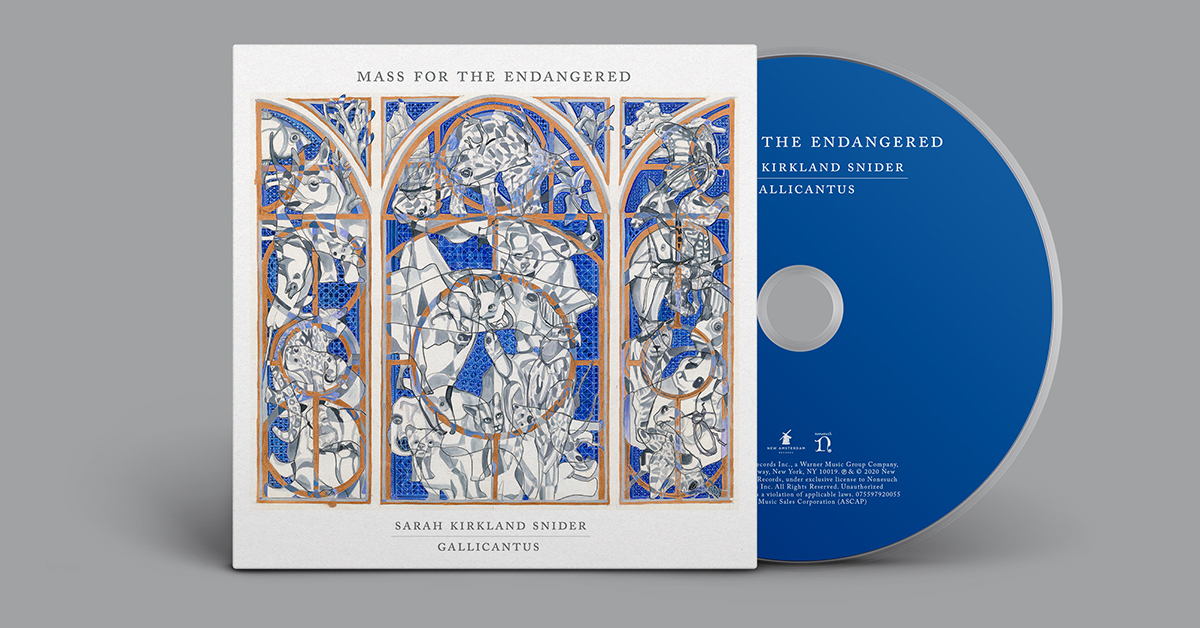
The six-movement Mass for the Endangered is a rumination on the concept of the traditional Catholic Mass, its fidelity enhanced by Snider’s interpolation of traditional Latin text for the Gloria, Sanctus/Benedictus, and parts of the Kyrie, Credo, and Agnus Dei. For the album art, Bellows created an illustrated triptych of endangered flora and fauna that evoke medieval Christian altarpieces and stained-glass windows.

Snider explains, “The origin of the Mass is rooted in humanity’s concern for itself, expressed through worship of the divine—which, in the Catholic tradition, is a God in the image of man. Nathaniel and I thought it would be interesting to take the Mass’s musical modes of spiritual contemplation and apply them to concern for non-human life—animals, plants, and the environment. There is an appeal to a higher power—for mercy, forgiveness, and intervention—but that appeal is directed not to God but rather to Nature itself.”

Growing up in Princeton, NJ, one-time home of the American Boychoir School, Snider attended that venerable institution’s co-ed summer camp as a youth: “I attended for five summers. I fell in love with choral singing there, and later sang with the Princeton High School Choir, which was at the time one of the most celebrated high school choirs in the country. These experiences were profoundly formative for me, and I learned a lot of the choral repertoire. I felt very at home in that music, but I hadn’t yet had a chance to explore it in my writing in a significant way. The Mass was my first large choral commission, and I was thrilled to immerse myself in memories of singing the Mozart, Brahms, and Fauré Requiems, the Palestrina and Byrd Masses, the Bach chorales.

“Rather than consciously upend those traditions,” she continues, “I wanted to open the gates in my mind between centuries-old European vocal traditions and those of more recent American vernacular persuasion, and write from a place where differing thoughts about line, text, form, and expression could co-exist.”

Recently called a “significant voice on the American music landscape” by the Philadelphia Inquirer and “an important representative of twenty-first century trends in composition” by New York Classical Review, composer Sarah Kirkland Snider writes music of direct expression and vivid narrative that has been hailed as “rapturous” by the New York Times, “groundbreaking” by the Boston Globe, and “poignant, deeply personal” by the New Yorker. With an ear for the poetic and the architectural, Snider’s music draws upon a variety of influences to render a nuanced command of immersive storytelling. Of her orchestral song cycle, Penelope, Pitchfork said: “Snider’s music lives in … an increasingly populous inter-genre space that, as of yet, has produced only a few clear, confident voices. Snider is perhaps the most sophisticated of them all.”

Snider’s works have been commissioned and performed by the New York Philharmonic, the San Francisco Symphony, the National Symphony Orchestra, the Detroit Symphony Orchestra, the Indianapolis Symphony Orchestra, the Kansas City Symphony, and the St. Paul Chamber Orchestra; the Residentie Orkest Den Haag, Aarhus Symfoniorkester, Britten Sinfonia, and National Arts Centre Orchestra; violinist Anne Akiko Meyers, percussionist Colin Currie, and vocalist Shara Nova (formerly Worden); eighth blackbird, A Far Cry, Ensemble Signal, The Knights, and yMusic; Roomful of Teeth, Cantus, and Trinity Wall Street Choir, among many others. Penelope and Unremembered, her first two LPs, earned critical acclaim from NPR, the New York Times, Washington Post, Los Angeles Times, Boston Globe, the Nation, and Pitchfork. Her music is published by G. Schirmer, Inc.

featuredimage
Sarah Kirkland Snider’s "Mass for the Endangered" [cd pkg]
  • Friday, September 25, 2020
    Sarah Kirkland Snider’s "Mass for the Endangered," Performed by Gallicantus, Out Now on New Amsterdam and Nonesuch Records

    Composer Sarah Kirkland Snider’s Mass for the Endangered, the fourth record in a partnership between New Amsterdam and Nonesuch Records, is out now. A video for “Alleluia” from the Mass, the third video for the album made by Deborah Johnson/CandyStations, can be seen below. Snider’s Mass, with a libretto by poet/writer Nathaniel Bellows, is a celebration of, and an elegy for, the natural world—animals, plants, insects, the planet itself—an appeal for greater awareness, urgency, and action. Originally commissioned by Trinity Church Wall Street, this recording features the English vocal ensemble Gallicantus conducted by Gabriel Crouch.

    "This emphatic articulation of purpose, sung by and for other humans, seems to be reaching beyond environmentalism and toward morality at large," says the New York Times. "Sarah Kirkland Snider, a rising star on the American compositional scene," says the Wall Street Journal, "describes her piece as a prayer for endangered wildlife and their imperiled environments. More plea than polemic, the first recording of this riveting work … [is] elegiac and affecting."

    The six-movement Mass for the Endangered is a rumination on the concept of the traditional Catholic Mass, its fidelity enhanced by Snider’s interpolation of traditional Latin text for the Gloria, Sanctus/Benedictus, and parts of the Kyrie, Credo, and Agnus Dei. For the album art, Bellows created an illustrated triptych of endangered flora and fauna that evoke medieval Christian altarpieces and stained-glass windows.

    Snider explains, “The origin of the Mass is rooted in humanity’s concern for itself, expressed through worship of the divine—which, in the Catholic tradition, is a God in the image of man. Nathaniel and I thought it would be interesting to take the Mass’s musical modes of spiritual contemplation and apply them to concern for non-human life—animals, plants, and the environment. There is an appeal to a higher power—for mercy, forgiveness, and intervention—but that appeal is directed not to God but rather to Nature itself.”

    Growing up in Princeton, NJ, one-time home of the American Boychoir School, Snider attended that venerable institution’s co-ed summer camp as a youth: “I attended for five summers. I fell in love with choral singing there, and later sang with the Princeton High School Choir, which was at the time one of the most celebrated high school choirs in the country. These experiences were profoundly formative for me, and I learned a lot of the choral repertoire. I felt very at home in that music, but I hadn’t yet had a chance to explore it in my writing in a significant way. The Mass was my first large choral commission, and I was thrilled to immerse myself in memories of singing the Mozart, Brahms, and Fauré Requiems, the Palestrina and Byrd Masses, the Bach chorales.

    “Rather than consciously upend those traditions,” she continues, “I wanted to open the gates in my mind between centuries-old European vocal traditions and those of more recent American vernacular persuasion, and write from a place where differing thoughts about line, text, form, and expression could co-exist.”

    Recently called a “significant voice on the American music landscape” by the Philadelphia Inquirer and “an important representative of twenty-first century trends in composition” by New York Classical Review, composer Sarah Kirkland Snider writes music of direct expression and vivid narrative that has been hailed as “rapturous” by the New York Times, “groundbreaking” by the Boston Globe, and “poignant, deeply personal” by the New Yorker. With an ear for the poetic and the architectural, Snider’s music draws upon a variety of influences to render a nuanced command of immersive storytelling. Of her orchestral song cycle, Penelope, Pitchfork said: “Snider’s music lives in … an increasingly populous inter-genre space that, as of yet, has produced only a few clear, confident voices. Snider is perhaps the most sophisticated of them all.”

    Snider’s works have been commissioned and performed by the New York Philharmonic, the San Francisco Symphony, the National Symphony Orchestra, the Detroit Symphony Orchestra, the Indianapolis Symphony Orchestra, the Kansas City Symphony, and the St. Paul Chamber Orchestra; the Residentie Orkest Den Haag, Aarhus Symfoniorkester, Britten Sinfonia, and National Arts Centre Orchestra; violinist Anne Akiko Meyers, percussionist Colin Currie, and vocalist Shara Nova (formerly Worden); eighth blackbird, A Far Cry, Ensemble Signal, The Knights, and yMusic; Roomful of Teeth, Cantus, and Trinity Wall Street Choir, among many others. Penelope and Unremembered, her first two LPs, earned critical acclaim from NPR, the New York Times, Washington Post, Los Angeles Times, Boston Globe, the Nation, and Pitchfork. Her music is published by G. Schirmer, Inc.

    Journal Articles:Album ReleaseArtist News

Enjoy This Post?

Get weekly updates right in your inbox.
Thank you!
x

Welcome to Nonesuch's mailing list!

Customize your notifications for tour dates near your hometown, birthday wishes, or special discounts in our online store!

Related Posts

  • Thursday, December 4, 2025
    Thursday, December 4, 2025

    Composer Sarah Kirkland Snider’s fifth full-length LP, a new, all-orchestral album Forward Into Light, produced by Silas Brown and recorded by Metropolis Ensemble led by artistic director/conductor Andrew Cyr, is due February 27 on New Amsterdam / Nonesuch Records. It features Forward Into Light, inspired by the American women’s suffrage movement; the string orchestra and harp (Noël Wan) version of Drink the Wild Ayre; Eye of Mnemosyne, a work on memory, innovation, and culture; and Something for the Dark, a meditation on resilience. Snider says: “I chose to create an album of these four works because they share themes of perseverance, alliance, and evolution through dark and light—concepts that have been at the forefront of my mind in recent years."

    Journal Topics: Album ReleaseArtist News
  • Tuesday, December 2, 2025
    Tuesday, December 2, 2025

    After a nearly five-decade career as one of his generation’s defining rock bassists, time and space have finally allowed Flea to work with a dream band of modern jazz visionaries, returning to his first instrument and musical love, the trumpet, for a new album to be released in 2026 on Nonesuch. A preview, Flea’s original song “A Plea,” is out now. Written and performed by Flea, “A Plea” urges listeners to “build a bridge, shine a light, make something beautiful and see somebody, give it to somebody.” Featuring Flea on electric bass, vocals, and trumpet, the ensemble also includes double bassist Anna Butterss and guitarist Jeff Parker, as well as drummer Deantoni Parks, percussionist Mauro Refosco, alto flutist Rickey Washington, and trombonist Vikram Devasthali. Chris Warren joins on vocals, as does the song’s producer Josh Johnson, who also plays alto saxophone. Also out today: a music video, directed by Clara Balzary and featuring choreography by Sadie Wilking.

    Journal Topics: Album ReleaseArtist NewsVideo